Limewash walls: what to know before you pick up a brush
No other finish moves across a wall quite like limewash. Here’s what it actually is, why it suits older homes so well, and how to bring it into yours.
Rachel Hannah
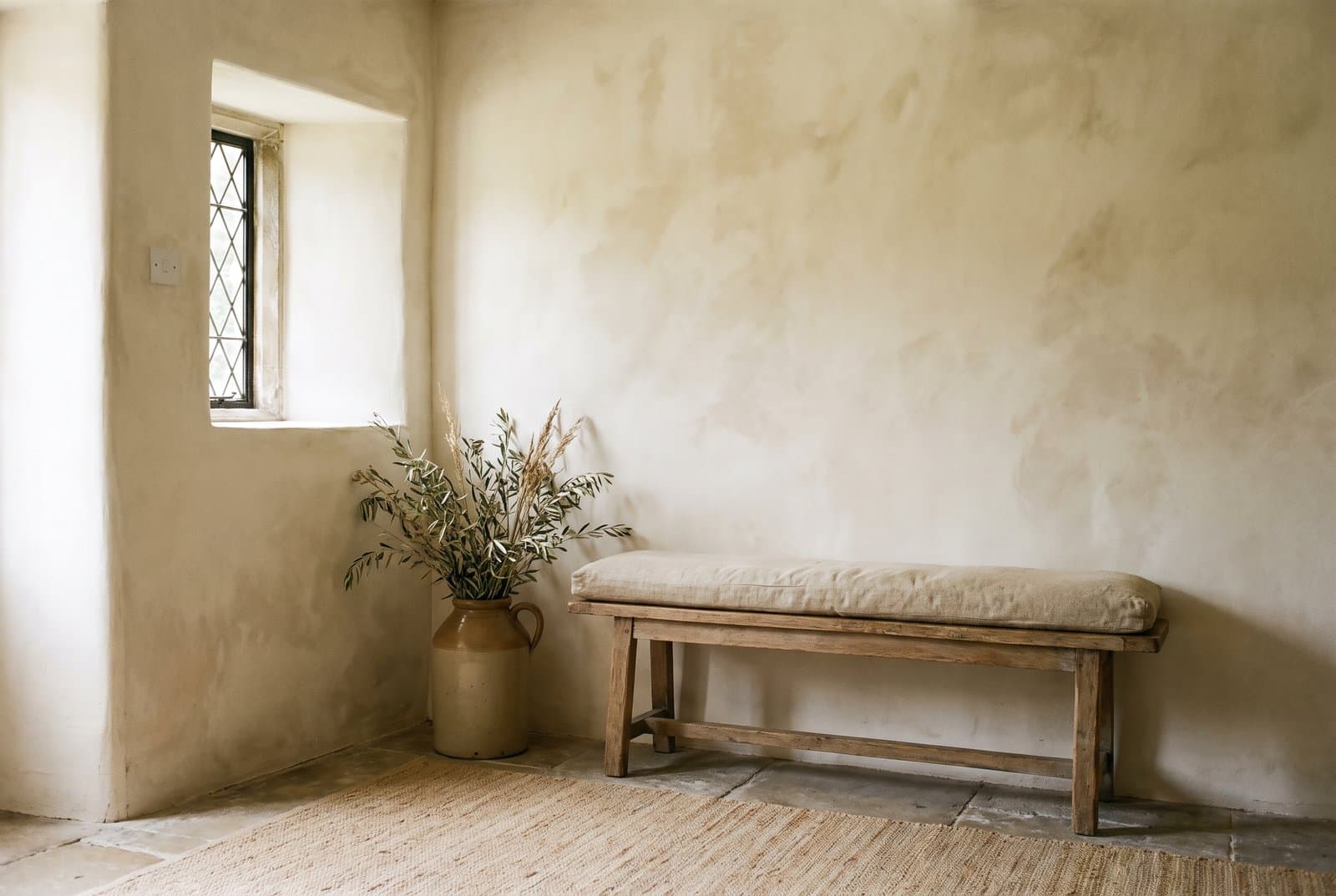
If there is one finish that sums up the rooms I love most, it’s limewash. A wall that looks soft rather than flat, clouded and gently mottled, a little lighter in one place and a little deeper in another, and completely matt. It changes through the day as the light moves round, and it makes even a plain room feel as though it has a story.
It turns up again and again in the looks I’ve written about, from French country interiors to English country interiors, and it’s one of the materials at the heart of rustic luxury. So here’s what limewash actually is, where it works, where it doesn’t, and how to bring the feeling home.
What limewash actually is
Traditional limewash is about as simple as a wall finish gets: lime, water and, if you want colour, natural pigment. It’s been used on cottages, barns and churches for centuries, inside and out.
The clever part happens after it goes on. As it dries, the lime slowly takes in carbon dioxide from the air and turns back into calcium carbonate, which is essentially limestone. So rather than a film of paint sitting on the surface, you end up with a thin mineral layer that becomes part of the wall.
That is where the look comes from. Limewash goes on unevenly by nature, soaks into the wall at different rates, and dries in soft clouds of tone. No two walls finish quite the same, and that’s rather the point.
Why it suits older homes so well
Old houses with solid walls of stone, brick or lime plaster need to breathe. Moisture moves in and out of them naturally, and the finish on the wall has to let it go. Limewash does exactly that.
Many modern paints form a tighter skin, and on an old solid wall that can trap damp behind it, which is often when you see bubbling, flaking and that musty smell. Limewash is also naturally alkaline, which makes the surface an unwelcoming place for mould.
If you live in a listed building, it’s always worth a word with your local conservation officer before changing any wall finish. Lime is very often what they would recommend in any case.
Where limewash works, and where it doesn’t
This is the part people tend to find out the hard way. Limewash needs a porous, mineral surface to bind to: lime plaster, bare brick, stone, or a suitable bare plaster. That is where it’s at its best.
It won’t take on a wall that has already been painted with ordinary emulsion, because there’s nothing for the lime to grip. Some makers sell a special primer that lets it go over painted walls, so check with the maker of whichever product you’re looking at before you begin.
It’s also a soft, chalky finish. It can rub off a little on a sleeve and marks more easily than a wipeable paint, so I’d keep it away from the splashback, the boot room wall that takes every wet dog, and anywhere small hands like to lean. On a living room, a bedroom, a hallway or a stairwell, it’s lovely.
Limewash and limewash-effect paint
You’ll also see paints sold as limewash-effect or lime paint. Some are genuinely mineral-based, and others are modern paints made to imitate the look. They can be a good choice, especially over walls that are already painted, but they won’t all behave like true limewash on an old wall that needs to breathe. If that matters in your home, check what’s actually in the tin.
How it’s applied
Limewash isn’t difficult, but it is different from rolling on emulsion, so here are the basics as I understand them. Always follow the instructions from the maker of the product you choose.
Protect yourself first
Lime is caustic. Wear gloves, long sleeves and eye protection, and keep it well away from children and pets while you work.
Prepare the wall
The surface should be clean, sound and free of dust. A traditional finish usually asks for the wall to be lightly dampened before each coat, so the lime doesn’t dry too quickly.
Use a big brush and loose strokes
A wide brush, worked in crossing strokes rather than neat lines, gives the soft, cloudy movement. Thin coats are better than thick ones, and it usually takes several.
Be patient with the colour
Limewash looks far darker when it’s wet and dries much lighter, so don’t judge it until it has dried properly. Try a sample patch first, and look at it in the morning and the evening.
Mind the weather
Hot sun, frost and draughts can all make it dry too fast or fail to cure. A mild, still day is ideal, especially outside.
Choosing a limewash colour
Limewash is at its most beautiful in soft, earthy colours. Warm whites, chalk, oat, stone, a pale clay pink, a faded sage. These are the colours of natural pigments, and they all sit very happily beside oak, linen and terracotta.
I’d avoid brilliant white, which can feel cold in softer British light. A warm white gives you the same freshness with far more depth. And because limewash is never one flat tone, a gentle colour reads as richer on the wall than it does on the chart.
If you rent
Limewash isn’t a finish you can easily undo, so it isn’t one to try in a rented home without your landlord’s blessing. If they’re happy, a limewash-effect paint over the existing walls is usually the more practical route.
And if the answer is no, you can borrow the feeling in other ways: a chalky, matt paint where painting is allowed, plenty of natural linen, and warm lamplight, which flatters any wall. There’s more in 7 ways to make a rented home feel like yours.
Limewash, the Sunday Ambience way
Rustic luxury is built on honest, matt materials, and limewash may be the purest of them all. It suits a cottage, a farmhouse or a period home perfectly, and it can bring real softness to a newer house too, where the walls are suitable or with the right product.
When I design a room, the walls come first, and every design includes a named paint colour list and the right finish for every surface. If limewash is right for your walls, it goes on the list. If it isn’t, you’ll get the closest honest alternative rather than a finish that will let you down. It’s one of the reasons I care so much about sustainable interior design: the best finish is the one that suits the house and lasts.
If this is the home you’d like
Limewash rewards a slow approach. Start with one wall, live with it for a while, and watch how it changes with the light.
If you’d like some help, Sunday Ambience designs entirely online, from your photographs and a few measurements, with every design led and approved by me. Tell me you love limewash and it becomes part of the brief, set within the studio’s rustic luxury style.
The Signature Interior Design package is £1,495 for one room, designed in real depth, with photorealistic visuals and a live concept call. If you’d prefer to begin more gently, Room Ambience is the lighter option at £495.
Or simply send me a few photographs and tell me what isn’t quite working. I read every message myself, and there’s no obligation of any kind.