French country interiors without the farmhouse in Provence
Limewashed walls, creased linen and a table at the heart of the house. Here’s what makes French country interiors so calm, and how they sit beside their English cousin.
Rachel Hannah
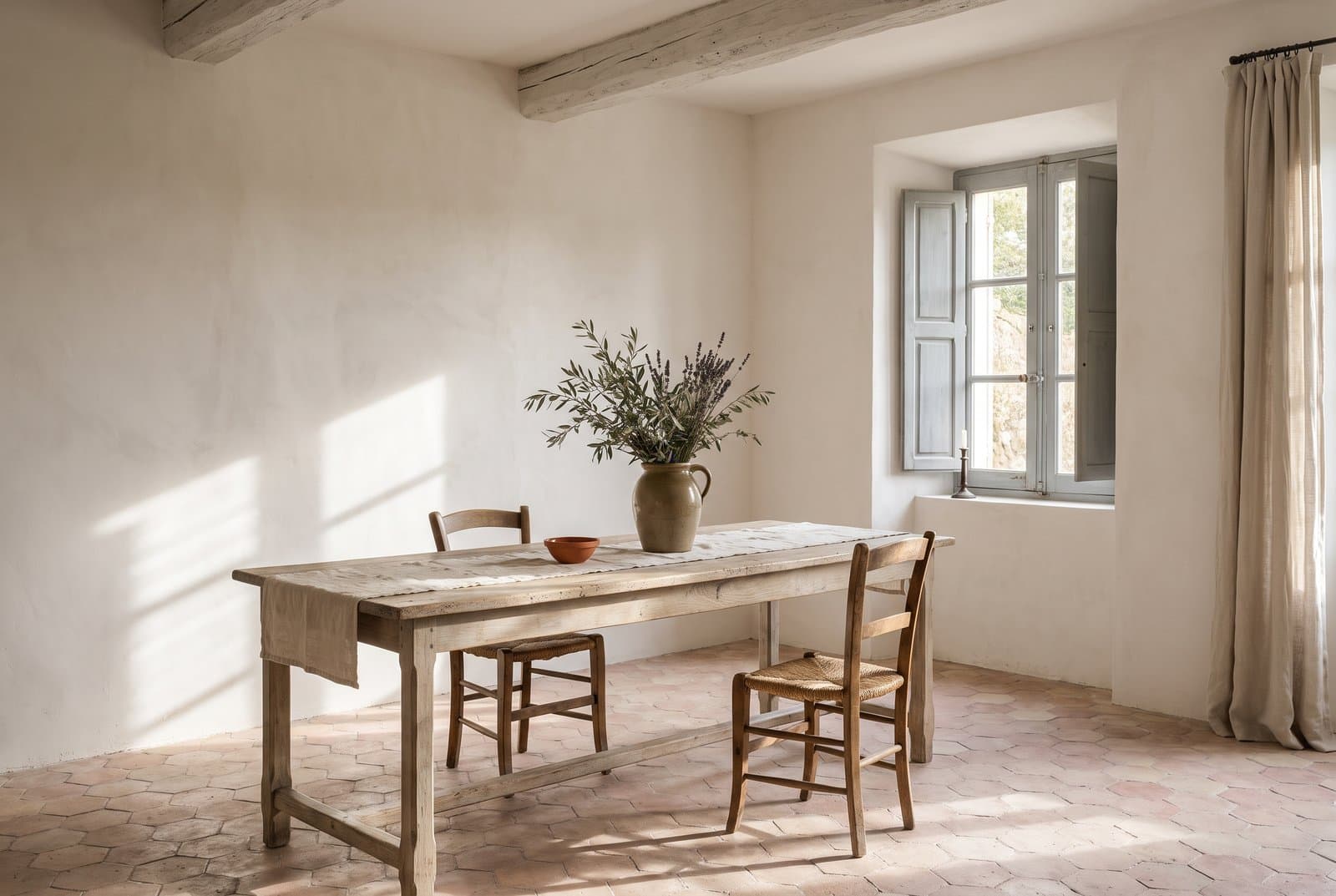
French country interiors have a way of looking effortless. Limewashed walls, a long table worn smooth by decades of lunches, linen at the window, and shutters half closed against the afternoon sun. Very little in the room, and nothing in it trying too hard.
It’s a close cousin of the look I wrote about in English country interiors: 7 ways to do it without clutter, and both sit within rustic luxury, the one style Sunday Ambience designs in. Here’s what defines French country interiors, how they differ from their English cousin, and how to bring the feeling home without a farmhouse in Provence.
What French country interiors actually are
French country style comes from the farmhouses and village houses of rural France, most famously those of Provence. Like English country, it was never really designed. It’s what happens when practical people build with what the land around them offers, and then leave well alone for a century or two.
So the materials come first. Thick walls finished in lime. Stone or terracotta underfoot, cool in summer. Beams left bare. Shutters at the windows. None of it was chosen to look pretty, and all of it does.
The furniture follows the same logic. A long table at the centre of the house. Rush-seated chairs. A tall armoire in place of fitted cupboards. Painted pieces whose paint has worn thin at the edges, through nothing but use. And linen everywhere, on the bed, at the window and over the table.
The colours are those of the landscape after a long summer: warm white, stone, straw, a faded blue-grey, soft olive green and the dusty pink of old terracotta.
Why it feels so calm
Three things give French country its ease.
The first is light. These rooms were built for strong sun, so the walls are pale and chalky and the surfaces matt, and the light that comes through the shutters lands softly. The second is sparseness. A French country room holds far less than you’d expect, and each piece has a job to do. The third is the table. Life in these houses is arranged around eating together, which gives the whole room a purpose and a centre.
It’s also a look entirely without shine. Everything has been softened by sun, water and hands, and that is why it feels so settled. I’ve written more about why matt wins in What is rustic luxury? Why matt, natural rooms feel so calm.
French country and English country: how they differ
The two are cousins, and they share the things that matter most. Both grew slowly. Both put comfort and honest materials ahead of fashion. Both look to the garden. And both are ruined the moment they’re faked.
The differences come down to weather.
English country was made for grey skies and long winters, so it turns inward. Deep upholstery, rugs, books, a fire, and a little pattern to cheer things along. French country was made for heat, so it opens outward. Hard, cool floors, bare walls, far less upholstery, and a door standing open to the courtyard.
An English country room is judged from the armchair. A French one is judged from the table.
English country gathers, and French country pares back. It’s why the two sit so well together, as I’ll come to in a moment.
Where French country can go wrong
The look has a few familiar ways of going wrong, and none of them has much to do with France.
The first is the gift shop version. Cockerels, lavender printed on everything, script lettering on the walls, and toile on every surface at once. Real French country houses are far plainer than that.
The second is new furniture, painted white and sanded at the corners to look old. Worn paint is lovely when a hundred years of use has done the wearing. Done in a factory, it’s a costume.
The third is a muddle of two different looks. Gilt, crystal and elaborate carving belong to the château, not the farmhouse. That is a different style altogether, and a far shinier one.
French country, the Sunday Ambience way
Of all the directions rustic luxury can lean, French country needs the least persuading. Limewash, linen, honed stone, clay and aged metal are the studio’s own materials already. The restraint is there from the start, and so is the empty space.
So if you love the feel of a French farmhouse, your design can lean that way, with hints of it woven through the studio’s rustic luxury style. What I leave out is very little: the motifs, the gilt, and anything pretending to be older than it is.
And you don’t have to choose between the two cousins. A room can borrow from both: the deep comfort of an English armchair, set against the bare walls and pale light of a French room. One calm palette holds them together.
There’s a third cousin further south, and I’ve written about it in Spanish country interiors: why lime and clay feel so restful.
How to bring French country into your own home
None of this needs a farmhouse, or a renovation. Here’s where I’d begin.
Start with the walls
Warm white, chalky and matt. Limewash if you’re able, because its gentle movement is the nearest thing to old lime plaster. I’d avoid brilliant white, which can feel cold in softer British light.
Find one good table
If the room has space for it, an old farmhouse table does more for this look than anything else. Scrubbed pine, oak or elm, with its marks left in. Buy it second-hand. That’s vintage first, which is how the studio sources in any case.
Choose linen, and leave it creased
Curtains, bedding, a tablecloth, a loose cover, in natural undyed tones or a soft washed colour. Don’t iron it. The creases are the point.
Let paint wear on its own
If you’d like a painted piece, buy an old one whose paint has aged naturally, or paint something yourself in a matt finish and let time do the rest. Skip anything sold as distressed.
Bring in clay, stone and old metal
Terracotta pots, a stoneware jug, a marble board, an iron candlestick, brass that has been allowed to dull. Small things, but they carry the feeling of the floors and walls you may not be able to change.
Keep pattern to one
A ticking stripe, a small check or a single piece of toile. One is charming. A roomful is a theme.
Take something away
French country rooms are sparse. Once the room feels finished, remove two things and see whether you miss them.
If you rent, work with what moves
Almost all of this is freestanding, so it suits a rented home well. The table, the linen, the pots and the lamps all leave with you. There’s more in 7 ways to make a rented home feel like yours.
The courtyard is part of the house
In French country, the outdoor space isn’t a separate project. It’s another room, and often the best one.
Gravel underfoot. A table in the shade of a tree or a vine. Terracotta pots of lavender, rosemary and thyme, which are happy in a sunny, free-draining spot in a British garden too. An olive in a large pot, somewhere sheltered. A balcony can hold a small version of all of it.
The studio designs outdoor spaces in the same way as rooms, with peat-free planting, and I’ve explained how in Online garden design: can it really work from a few photos?.
If this is the home you’d like
French country was never made in a hurry, and it needn’t be now. Begin with the walls and a table, and let the rest arrive slowly.
If you’d like some help, Sunday Ambience designs entirely online, from your photographs and a few measurements, with every design led and approved by me. Tell me you love the French country feel, the English one, or a little of both, and it becomes part of the brief, set within the studio’s rustic luxury style.
The Signature Interior Design package is £1,495 for one room, designed in real depth, with photorealistic visuals and a live concept call. If you’d prefer to begin more gently, Room Ambience is the lighter option at £495.
Or simply send me a few photographs and tell me what isn’t quite working. I read every message myself, and there’s no obligation of any kind.