Spanish country interiors: why lime and clay feel so restful
Whitewashed walls, terracotta floors, dark beams and a door open to the courtyard. Here’s what makes Spanish country interiors so restful, and how to bring that warmth home.
Rachel Hannah
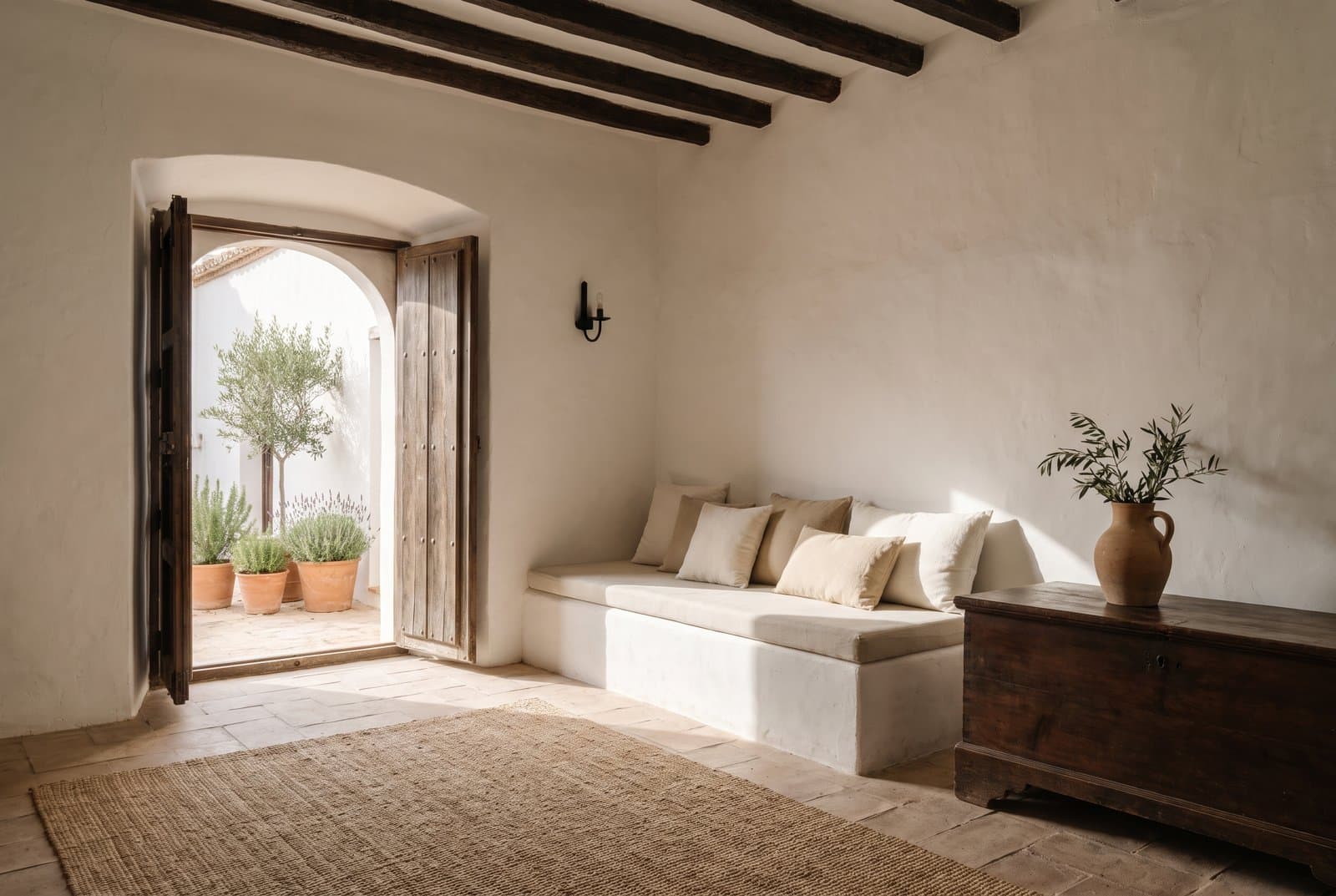
Spanish country interiors are built around one idea: staying cool and living slowly. Thick whitewashed walls, terracotta underfoot, dark old beams, and a doorway opening onto a shaded courtyard full of pots. The rooms are almost bare, and they’re among the most restful there are.
It’s the third in a small family of looks I’ve been writing about, after English country interiors: 7 ways to do it without clutter and French country interiors without the farmhouse in Provence. You’ll also hear it called Spanish rustic or Mediterranean rustic style, and it shares its materials with rustic luxury, the one style Sunday Ambience designs in. Here’s what defines it, where its luxury really lies, how it differs from its northern cousins, and how to bring some of that warmth home.
What Spanish country interiors actually are
The look comes from the farmhouses and village houses of rural Spain: the cortijos of Andalusia, the fincas of the Balearic Islands, and the whitewashed houses of the southern hill villages. Like its English and French cousins, it was never really designed. It was built by people with one pressing concern, which was the heat.
Everything follows from that. Walls are thick, which keeps the house cool, and finished in white lime, which throws the sun back. Windows are small and shuttered. Floors are terracotta, cool under bare feet. Ceilings are carried on dark timber beams.
The furniture is plain and sturdy, and there isn’t much of it. A heavy old table, a bench, a chest. Seating is often built into the wall itself and softened with cushions. Woven esparto grass turns up as baskets, mats and blinds. Hand-made ceramics sit on open shelves, and there’s a little wrought iron at the windows and the lamps.
And at the heart of it, very often, is the patio. A courtyard open to the sky, crowded with plants in clay pots. In a Spanish country house the outdoor room isn’t an extra. It’s the centre.
Why it feels so restful
Three things do the work.
The first is contrast. White walls against dark wood, bright sun against deep shade. It’s a stronger, simpler palette than the faded tones of French country, and it gives the eye very little to worry about. The second is weight. Thick walls, solid furniture and floors of stone or clay make a room feel anchored and permanent. The third is emptiness. In a hot country clutter is uncomfortable, so the rooms are kept clear and the air is left to move.
Nearly everything in the room is matt, softened by sun and use. It’s the quality I wrote about in What is rustic luxury? Why matt, natural rooms feel so calm.
Where Spanish luxury really lies
Luxury in a Spanish country house has nothing to do with gilt or gloss. The finest restored fincas and cortijos are quietly luxurious places, and what makes them so is space, shade, thick walls and very good materials, used plainly.
It’s luxury by craft and by place. Each region has its own, and the proper names are worth knowing.
In Mallorca, houses are built from marès, the island’s own pale sandstone, and dressed in roba de llengües, a flame-patterned ikat cloth still woven there. In Ibiza, the old farmhouses are low white cubes, with thick whitewashed walls and ceilings of juniper beams, known locally as sabina. In Andalusia, the cortijo gathers around its patio, with limewashed walls and floors of fired clay. And from Talavera de la Reina, in central Spain, comes hand-painted pottery whose making is recognised by UNESCO as intangible cultural heritage.
None of it shouts, and all of it is the real thing. That is Spanish luxury at its best, and it’s exactly the kind the studio believes in: quiet luxury with a rustic soul.
How it differs from English and French country
All three cousins share what matters. They grew slowly, they favour honest materials over fashion, and none of them survives being faked.
What separates them is the weather each was built for.
English country was made for grey skies, so it turns inward and layers up. French country was made for warm summers, so it pares back and opens the door. Spanish country was made for real heat, so it goes further still: barer, whiter, heavier, and built around shade.
An English country room is judged from the armchair, and a French one from the table. A Spanish one is judged from the shade.
It’s the plainest of the three, and the boldest. Where French country fades everything to a soft blue-grey, Spanish country keeps its whites white and its timber dark.
Where Spanish country can go wrong
The look has a few familiar ways of going wrong.
The first is the theme restaurant. Orange walls, heavy ironwork on everything, painted plates in rows and souvenirs on every surface. None of that belongs to a real Spanish farmhouse.
The second is too much dark wood. Heavy carved furniture in quantity turns a cool, calm room into a gloomy one. The look needs one or two dark pieces against a great deal of white.
The third is shine. Polished floor tiles and glossy glazes everywhere undo the whole effect. A little glaze is welcome, on a hand-made bowl or a few old tiles, but it should be the exception.
And one caution for British homes in particular. This look was made for strong sun. Under a grey sky, brilliant white walls and bare floors can feel cold when they were meant to feel cool. It needs warming up a little, which is where the studio comes in.
Spanish country, the Sunday Ambience way
The materials are the studio’s own already: limewash, clay, linen, honed stone, aged metal and old wood. So the Mediterranean feel sits naturally within rustic luxury, lighter and warmer than the English lean, and a little bolder than the French.
For a British home, I’d make three adjustments. Warm whites in place of brilliant white, with sand and soft terracotta beside them. Linen and cotton in generous amounts, so the bareness reads as calm and never as cold. And one or two dark, characterful pieces, kept well apart, where tradition might use a roomful.
What stays is the heart of it: the plain walls, the clay, the shade, and the door open to the garden.
You can borrow across the family too. An English armchair, a French table and a Spanish terracotta floor can share a room perfectly happily, so long as one calm palette holds them together.
How to bring Spanish country into your own home
None of this needs a finca. Here’s where I’d begin.
Warm the whites
Choose a soft, chalky white with a little warmth in it, and limewash if you’re able. Keep the ceiling, walls and woodwork close in tone, so the room reads as one calm shell.
Add clay
Terracotta is the signature of the look. Floor tiles if you’re renovating, and if not, large clay pots, a lamp base or a simple jug. Unglazed and matt, always.
Bring in woven texture
Esparto, jute, seagrass or rush, as a rug, a basket or a simple blind. It gives a bare room warmth without adding colour or clutter.
Choose one dark piece
An old chest, a bench or a table in dark wood, set against a pale wall with space around it. Buy it second-hand. That’s vintage first, which is how the studio sources in any case.
Keep fabric light
Unlined linen at the window, cotton on the bed, a few plain cushions. Nothing heavy, and very little pattern. A simple stripe is plenty.
Use glaze and iron sparingly
One hand-made bowl, a few old tiles behind a basin, a single iron lamp. These are the seasoning, not the meal.
Think about shade as well as light
The beauty of these rooms lies in soft, filtered light. Simple shutters, slatted blinds or a sheer linen curtain will do far more for the look than a bare window.
If you rent, work with what moves
The pots, the rug, the baskets, the linen and one good chest all leave with you. There’s more in 7 ways to make a rented home feel like yours.
The patio is the heart of it
If the look has a centre, it’s outdoors. A Spanish patio is simple: a pale wall, a floor of gravel, stone or clay, somewhere to sit in the shade, and pots. A great many pots, grouped closely, in plain terracotta.
In a British garden, the planting that suits it best is the planting that likes sun and sharp drainage: lavender, rosemary, thyme and sage, with an olive in a large pot somewhere sheltered. A vine or a climber over a simple pergola gives you the shade. A balcony can hold a small version of all of it.
The studio designs outdoor spaces in the same way as rooms, with peat-free planting, and I’ve explained how in Online garden design: can it really work from a few photos?.
If this is the home you’d like
Spanish country is the simplest of the three cousins, and the hardest to hurry. Begin with the walls, add clay and one good old piece, and stop sooner than you think you should.
If you’d like some help, Sunday Ambience designs entirely online, from your photographs and a few measurements, with every design led and approved by me. Tell me you love the Mediterranean feel and it becomes part of the brief, set within the studio’s rustic luxury style.
The Signature Interior Design package is £1,495 for one room, designed in real depth, with photorealistic visuals and a live concept call. If you’d prefer to begin more gently, Room Ambience is the lighter option at £495.
Or simply send me a few photographs and tell me what isn’t quite working. I read every message myself, and there’s no obligation of any kind.