Winter pots for your front door: 9 plants to pot up now
A pair of pots by the door is the first thing you see on a dark evening, and the first thing your guests see too. Here’s how to plant them now so they look calm and beautiful all winter.
Rachel Hannah
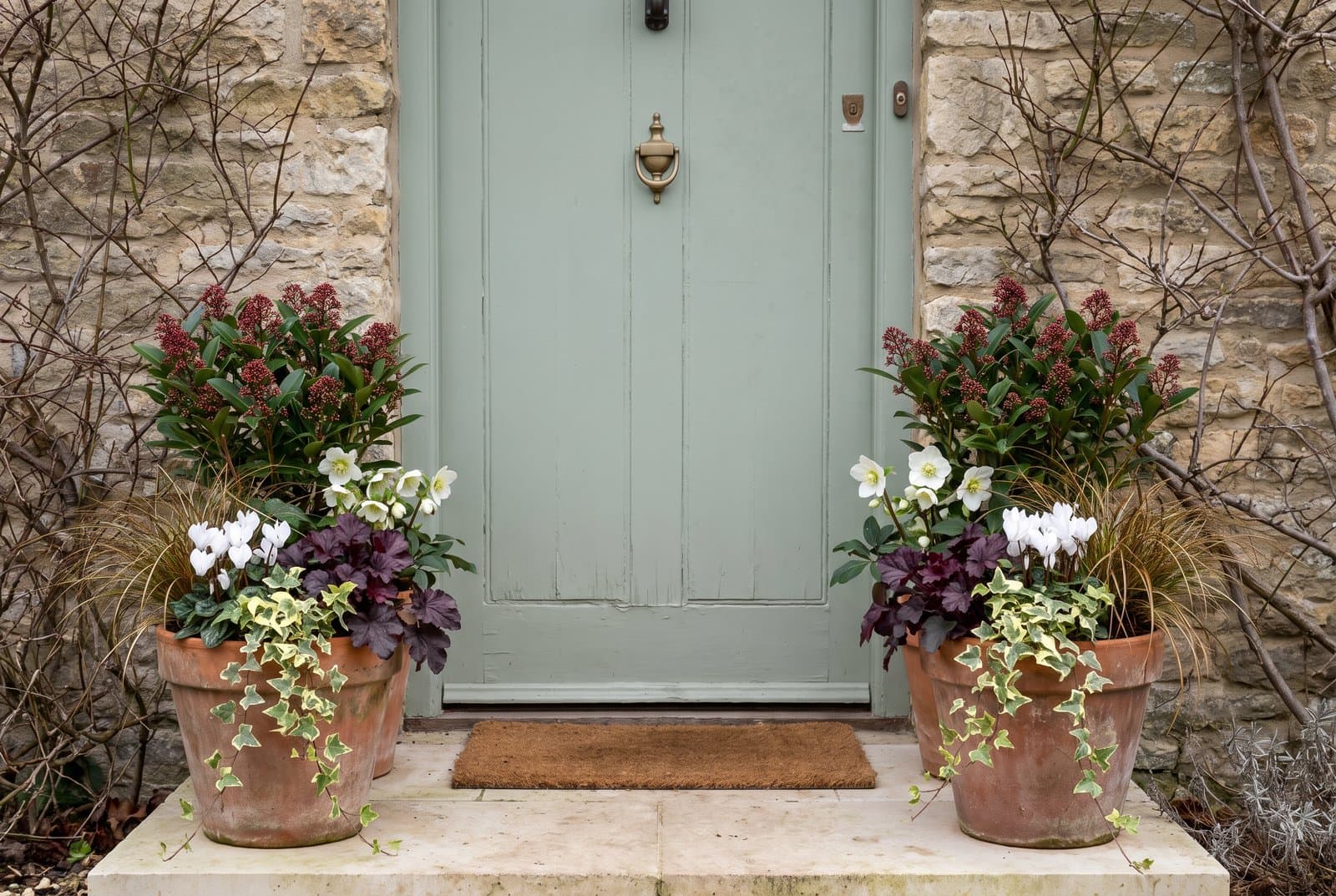
Winter pots for your front door are one of the loveliest small things you can do for a home. Through the darkest months, a pair of well planted pots says welcome long before anyone reaches the knocker, and late October is a good moment to plant them.
The trick is to choose plants that look good now, not ones that promise to grow. The RHS points out that winter plants barely grow at all, so buy good sized plants and fill the pot generously, for a full look from the very first day.
Start with the pots
Choose frost-proof, not frost resistant
Terracotta suits almost every front door, and it ages beautifully. But ordinary clay can crack in a hard frost, so look for pots labelled frost-proof. Gardeners’ World makes the point that this isn’t the same as frost resistant. Glazed stoneware, wood and good fibreglass pots are frost-proof options too.
Go bigger than you think
A small pot beside a full size door looks lost. As a rough guide, I like the planted pot to reach between a third and half the height of the door. A bigger pot also holds more compost, which stays moist for longer.
Raise them on pot feet
Set each pot on pot feet or a couple of bricks. The RHS recommends it, because the water drains away freely, and a pot that isn’t sitting in water is far less likely to freeze and crack.
Use peat-free compost
A peat-free multi-purpose compost is all you need. If you’re adding bulbs, the RHS suggests mixing in one part grit to three parts compost, so the bulbs never sit wet.
9 plants for winter pots
1. Skimmia
The backbone of a winter pot. Glossy evergreen leaves and tight clusters of buds all winter long. Skimmia japonica ‘Rubella’ has deep red buds that open into scented white flowers in spring.
2. Heuchera
For colour that lasts. The leaves come in burgundy, amber, lime and silver, and they stay all winter. ‘Burgundy Frost’ is one of the RHS’s top five plants for winter containers.
3. Hellebores
The Christmas rose, Helleborus niger, has clean white flowers that the RHS lists from December to March. It’s calm, classic and beautiful beside a sage or cream door.
4. Cyclamen
Little flowers in white, pink or crimson, with lovely marbled leaves. Choose the small hardy kinds, such as Cyclamen coum, rather than the larger indoor cyclamen sold at Christmas, which dislike frost. White keeps the look calm and pristine.
5. Violas and pansies
Another of the RHS top five, and for good reason: they keep flowering through mild spells. Pick a single colour, cream or deep purple, so the pot stays calm rather than busy.
6. Ivy
Trailing ivy softens the rim of the pot and ties it to the step. A variegated ivy with cream edges brightens a shady doorway.
7. Carex
A small evergreen sedge adds movement and fine texture. The bronze and copper ones look lovely against terracotta.
8. Gaultheria
Gaultheria mucronata has glossy berries in white, pink or red, and Gaultheria procumbens has red berries and leaves that turn bronze in the cold. Both like lime-free soil, so plant them in ericaceous compost.
9. Narcissus ‘Tête-à-tête’
The little daffodil on the RHS top five, and the reason to plant a layer of bulbs underneath. It flowers in early spring, just as the winter plants begin to tire.
Plant a layer of bulbs underneath
This is the secret of a pot that looks good from October to April. Plant the bulbs first, then the winter plants on top, and in spring the bulbs push up through them. Gardeners call it a bulb lasagne.
The RHS rule is to plant bulbs at three times their own depth. Put the largest, latest bulbs at the bottom, tulips for example, and the smallest at the top, such as crocus or ‘Tête-à-tête’, with a few centimetres of compost between each layer. The RHS suggests planting tulips in November, and daffodils ideally by the end of September, so if you’re adding daffodils now, plant them soon.
Keep it calm
Plant a matching pair, one each side of the door. Symmetry is the quickest way to make an entrance feel considered and intentional.
Keep to two or three colours, taken from the door and the house itself. A sage door suits burgundy, cream and green. A black door suits white and silver. Then repeat the same plants in both pots, so they read as a pair rather than two separate ideas.
Caring for winter pots
Winter pots need far less care than summer ones, but not none. Check the compost every week or so, because the RHS warns it can dry out in mild spells, especially under a porch. There’s no need to feed until spring. In a severe cold snap, the RHS suggests wrapping the pots in bubble wrap. And pick off fading flowers to keep everything neat.
If you have a dog that likes to dig, or small children, it’s worth knowing that the RHS lists daffodils, tulips, ivy and hellebores as harmful if eaten. For pets, the RHS points to the Horticultural Trades Association’s guide.
A garden that greets you
Your front door pots are the smallest garden of all, and often the one you see most. Garden, landscape and plant styling is coming soon at Sunday Ambience, designed online in the same calm, rustic style as the rooms inside. If you’d like to hear when it opens, you can register your interest there.
And if it’s the hallway behind the door that needs some love, send me a few photographs and tell me what isn’t quite working. I design everything online, from your photos and measurements, I read every message myself, and there’s no obligation of any kind.