Minimalist interior design: 9 ways to live with less and love your home more
Less stuff, more breathing room, and a home that feels calm the moment you walk in. Here’s how to do minimalism warmly, without the cold, empty showroom look.
Rachel Hannah
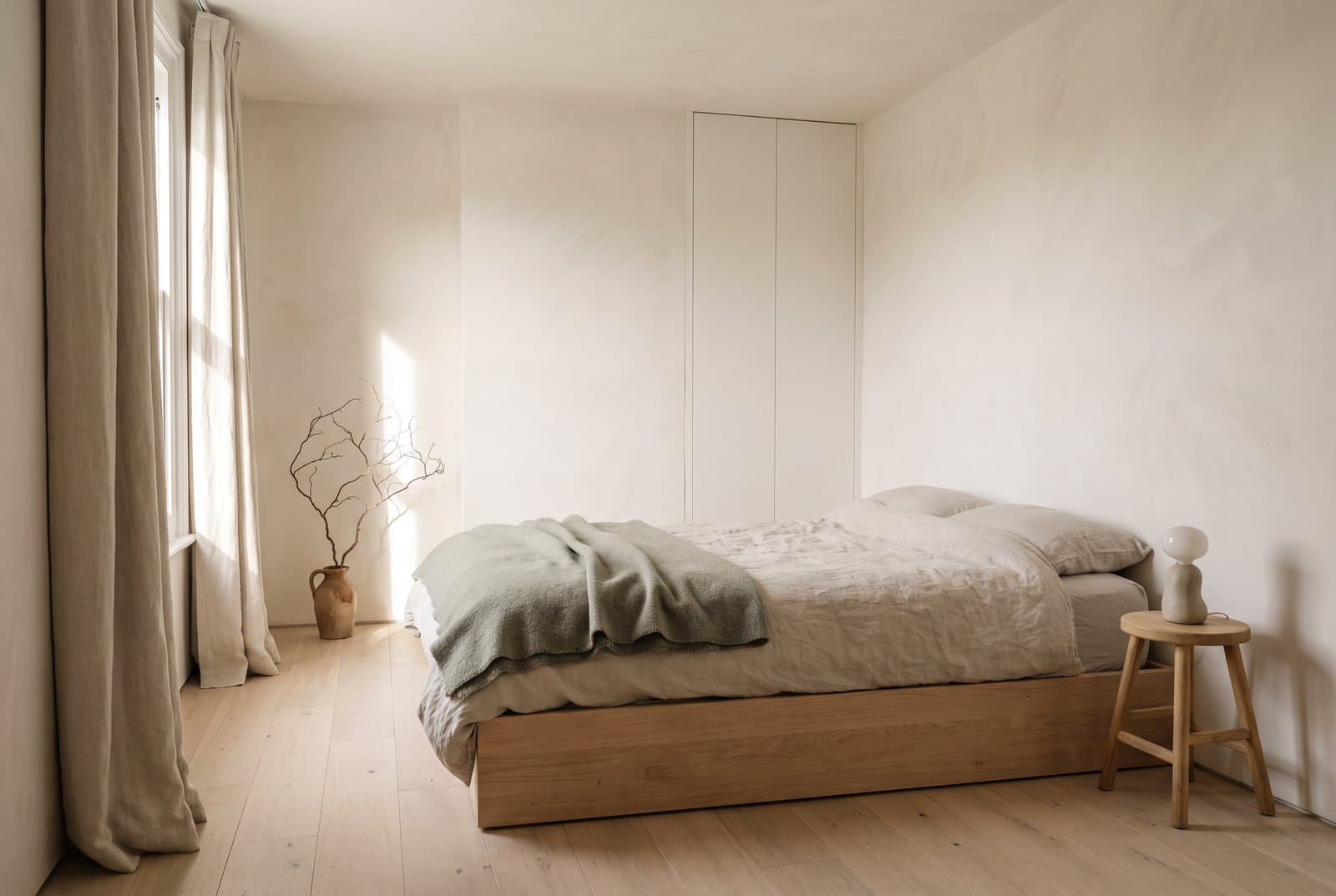
Minimalism has a reputation it doesn’t quite deserve. Say the word and most people picture white walls, a grey sofa, nothing on any surface and a room nobody could actually live in.
Real minimalism is gentler than that, and far more useful. It simply means keeping what you use and what you love, letting go of the rest, and giving the things that stay enough space to be enjoyed. Done well, a minimalist home doesn’t feel empty. It feels calm, generous and easy to live in.
Where minimalism comes from
The word comes from art. In the 1960s, a group of artists in New York, Donald Judd among them, began making work stripped back to simple forms and honest materials. Architects had been heading the same way for decades. Ludwig Mies van der Rohe made the phrase “less is more” famous, and in Britain the architect John Pawson has spent his career designing rooms of extraordinary quiet.
The idea is much older than the word, though. Japanese homes have practised it for centuries, as I wrote in Japanese interior design: 9 secrets to a calmer, quieter home. And in 1880 William Morris gave what may still be the best advice on the subject: “Have nothing in your houses that you do not know to be useful, or believe to be beautiful.”
Why minimalism can feel cold
When a minimalist room goes wrong, it’s almost always for the same reasons.
Too much white, and the wrong white. Brilliant white walls under a grey British sky look blue and chilly. Too little texture, so that every surface is smooth and hard. Harsh light from a single overhead fitting. And furniture chosen for how it looks in a photograph rather than how it feels to sit on.
The fix is not to add more things. It’s to make the few things you keep warmer, softer and better.
9 ways to live with less and love your home more
1. Edit before you buy anything
Minimalism starts with taking away. Work through one room at a time, one category at a time, and ask of every object whether it earns its place. Keep it, give it to someone who will use it, or let it go.
It’s the thinking behind the studio’s Space Edit, a calm, structured plan for one room, done from your photographs.
2. Give everything a home, and hide most of it
The secret of every calm minimalist room is storage. Closed cupboards, ideally built in and painted the same colour as the walls, so they almost disappear. When everything has a place to go, surfaces stay clear without any effort.
3. Choose fewer, better pieces
One good sofa instead of a sofa and two chairs. One beautiful table instead of three small ones. Buy the best you can afford, in solid, natural materials, and plan to keep it for a very long time.
4. Warm up the palette
Warm whites, oat, stone, clay and soft green, with wood to ground it all. Keep the colours close together, so the room reads as one calm whole, and nothing jumps out.
5. Let texture do the decorating
In a room with very few objects, texture matters more than ever. Limewashed walls, oiled oak, creased linen, a wool throw, a jute rug. The eye still has plenty to enjoy, and none of it is clutter.
6. Clear the surfaces
Surfaces are where clutter gathers first. Keep worktops, tables and windowsills almost empty, with perhaps one object on each. You’ll be surprised how much calmer a room feels when you can see its surfaces.
7. Layer soft, low light
Swap the big overhead light for two or three lamps at different heights, with warm bulbs. Minimalist rooms depend on light, because there’s so little else to create atmosphere.
8. Let one thing be the star
A minimalist room is the perfect setting for one beautiful thing: a piece of art, an old chest, a branch in a jug. With nothing competing for attention, it gets the admiration it deserves.
9. Keep it that way, gently
Minimalism isn’t a single clear-out, it’s a habit. A simple rule helps: when something new comes in, something old goes out. A quick tidy each evening keeps the calm without any great effort.
Minimalism with a family
A lived-in home will never look like an empty showroom, and it shouldn’t. Minimalism with children, pets and busy lives is about systems rather than perfection: a basket for each person, a shelf for the things in use this week, and toys that live in a cupboard rather than across the floor.
The aim isn’t a house with nothing in it. It’s a house where everything has somewhere to go.
Minimalism and sustainability
Buying less is the simplest sustainable choice there is. Fewer, better things, kept for longer and mended when they wear, are kinder to the planet than any amount of eco-labelled shopping. I’ve written more about this in Sustainable interior design without the greenwash.
A minimalist garden
The same thinking works outdoors. A simple gravel or stone floor, one tree with a beautiful shape, a single generous bench, and planting in a few repeated varieties rather than one of everything. Leave space for the light and the seasons to do their work, and keep the planting peat-free.
The studio designs gardens, courtyards and balconies in the same way as rooms, and I’ve explained how in Online garden design: can it really work from a few photos?.
Minimalism and rustic luxury
Rustic luxury, the one style Sunday Ambience designs in, shares minimalism’s heart: far fewer, far better things, and space to enjoy them. It simply adds warmth, with honest matt materials, aged brass, old timber and textiles you want to touch. You could call it minimalism that feels like home.
If you love a pared-back home, tell me and it becomes part of your brief. And if you’d like to start with the edit, the Space Edit is £95 for one room.
If this is the home you’d like
The Sunday Signature package is £1,495 for one room, designed in real depth, with photorealistic visuals and a concept walk-through with Rachel, live or pre-recorded. If you’d prefer to begin more gently, Room Ambience is the lighter option at £495, with one photorealistic visual of your finished room.
Or simply send me a few photographs and tell me what isn’t quite working. I read every message myself, and there’s no obligation of any kind.