Japanese interior design: 9 secrets to a calmer, quieter home
Paper screens, bare floors, one branch in a vase and a great deal of quiet. Here’s what makes a Japanese room so restful, and how to borrow its secrets at home.
Rachel Hannah
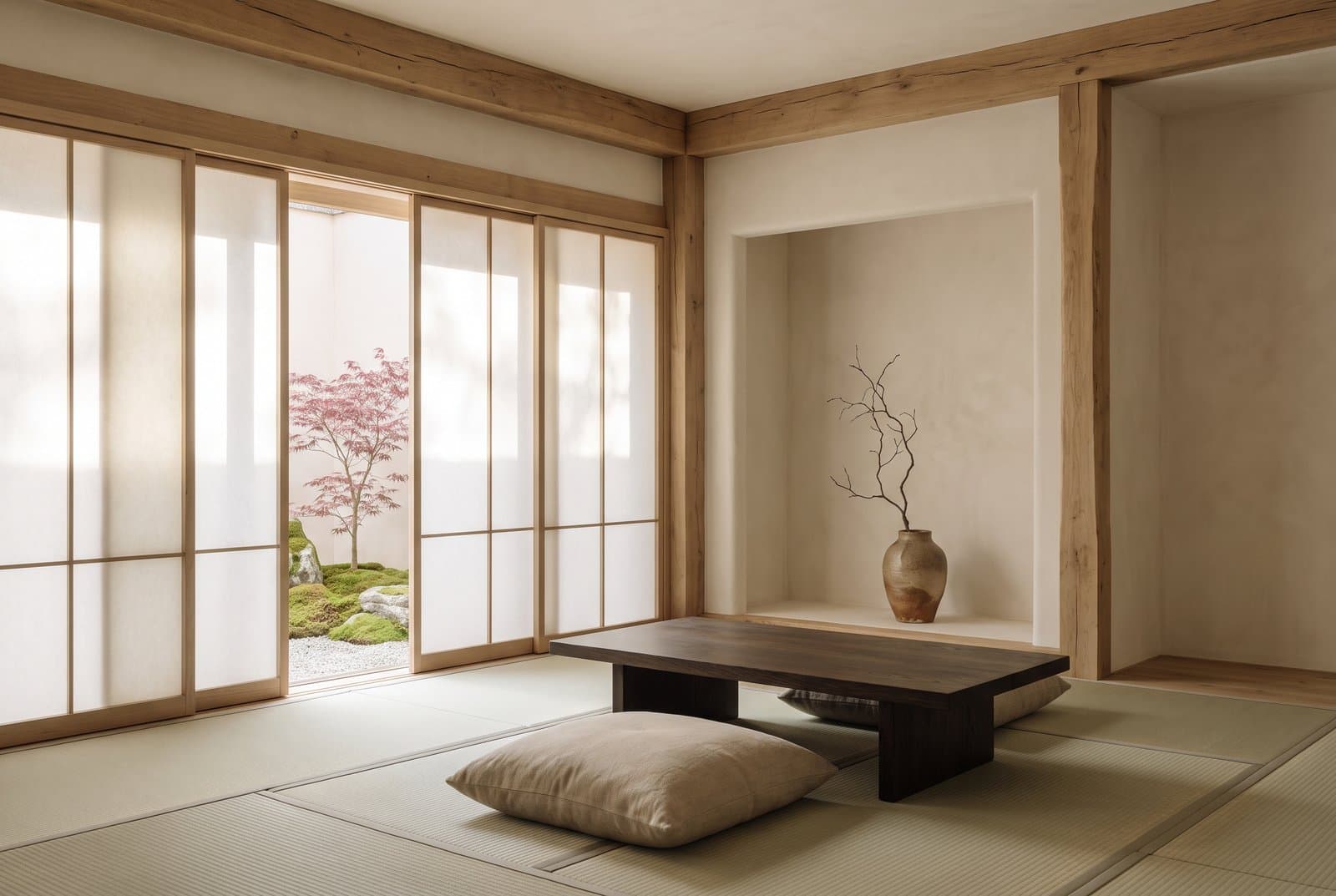
Few homes in the world are as calm as a traditional Japanese one. Paper screens soften the daylight, the floors are bare and warm underfoot, and the room holds almost nothing, yet it never feels empty. It feels finished.
That calm isn’t an accident. It comes from a handful of ideas that Japanese builders and craftspeople have refined for centuries, and the good news is that almost all of them travel. You don’t need a tatami room to use them. You need to understand what they are doing.
Japanese design is also one half of Japandi, the blend with Scandinavian style that has become so popular, and I’ve written about that separately in Japandi interior design: 7 ways to make it warm, not cold. Here, I want to go back to the source.
The 9 secrets of a Japanese room
1. Ma: the space between things
Ma is the Japanese idea of the pause, the gap, the space around and between things. In a room, it means that empty floor and bare wall are not waiting to be filled. They are part of the design, as important as anything placed in them.
It’s the single most useful idea to borrow. Before you add anything to a room, ask what the space around it will do. A chair with room to breathe looks considered. The same chair squeezed into a corner looks like storage.
2. Wabi-sabi: beauty in the imperfect
Wabi-sabi finds beauty in things that are imperfect, worn and impermanent: a hand-thrown bowl with an uneven rim, timber that has silvered, linen that creases. It’s the reason a Japanese room never looks brand new, and never tries to.
It’s also the thinking behind kintsugi, the craft of mending broken pottery with lacquer and gold, so that the repair becomes part of the story rather than something to hide.
3. Materials left honest
Wood, paper, clay, rush, stone and plaster, used plainly and left to age. Cedar and cypress are favourites in Japan, often left unpainted so that their grain and scent stay part of the room.
Everything is matt. There is very little gloss in a traditional Japanese interior, and that, more than anything, is why it feels soft. It’s the same quality I wrote about in What is rustic luxury? Why matt, natural rooms feel so calm.
4. Light that is filtered, never harsh
Shoji, the sliding screens of translucent washi paper in a timber lattice, turn daylight into a soft, even glow. There is no glare and no hard shadow, just gentle light across the whole room.
The novelist Jun’ichirō Tanizaki wrote a whole essay on this, In Praise of Shadows, published in 1933. His point was that Japanese rooms are designed for dimness and shade, and that their beauty lives in half-light. It’s a lovely thing to read on a winter evening, and it will change how you light your home.
5. Living close to the floor
Traditional Japanese rooms are furnished low: tatami mats underfoot, cushions to sit on, low tables and beds folded away by day. Rooms are even measured by how many tatami mats they hold.
Low furniture makes a ceiling feel higher and a room feel larger and quieter. You don’t have to sit on the floor to borrow it. A low sofa, a low table and nothing tall in the middle of the room give a similar effect.
6. Rooms that change their shape
Sliding screens, the translucent shoji and the solid fusuma, mean that a Japanese house can open up into one space or close down into small, quiet ones. A room is defined by what it’s being used for, not by fixed walls.
In a British home, the same flexibility comes from a curtain across an alcove, a folding screen, or furniture light enough to move.
7. One beautiful thing, given a place
The tokonoma is a shallow alcove kept for a single scroll, a flower arrangement or one treasured object, changed with the seasons. It is the only decorated place in the room, and it’s all the more beautiful for it.
It’s a wonderful habit to borrow. Choose one shelf, one niche or one corner, and give it to a single object, or a branch in a jug. Change it when the season turns.
8. The garden is part of the room
Many Japanese houses have an engawa, a wooden veranda that runs along the edge of the house, half in and half out. Open the screens and the garden becomes the view, and the room seems to carry on outside.
Japanese gardens even have a name for using a view beyond their boundary, shakkei, or borrowed scenery. A distant hill, a neighbour’s tree or a patch of sky becomes part of the design.
9. Leave the outside at the door
The genkan is the entrance of a Japanese home, usually a step lower than the rooms beyond, where shoes come off. It marks a clear line between the busy world and the calm one.
Even without the step, a proper landing place by the door, somewhere to sit, a place for shoes and a hook for every coat, changes how a home feels the moment you walk in.
Where Japanese style can go wrong
The quickest way to lose the calm is to treat it as a theme. Paper fans on the wall, bamboo everything and a souvenir from every shop add clutter, which is the opposite of the point.
The second is coldness. Borrow the emptiness without the warm materials and you get a bare, chilly room, especially under a grey British sky. Japanese rooms are sparse, but every surface in them is soft, natural and warm to the touch.
The third is buying the look all at once. A Japanese room is about restraint and craft, and both take time.
Bringing it into a British home
None of this needs a renovation. Here’s where I’d begin.
Clear one room properly
Ma starts with less. Take everything out of one room, then bring back only what you use or love. It’s the most powerful change on this list, and it costs nothing.
Soften the windows
Unlined linen curtains or a fine paper or fabric blind will give you much of the glow of shoji. Keep them pale and plain.
Lower the furniture
A low sofa, a low table and lamps at sitting height bring the room’s centre of gravity down, and it immediately feels calmer.
Choose a few natural, matt materials
Oiled wood, limewash or clay plaster, linen and stoneware. Keep the palette to warm whites, stone, oat and wood.
Make your own tokonoma
One niche, one shelf or one corner, given to a single thing. Change it with the seasons.
Light for the evening
Turn off the big overhead light and use several low lamps and a paper shade instead. Tanizaki would approve.
Mark the threshold
A bench, a basket for shoes and a hook for every coat, so the day stays at the door.
If you rent, start with what moves
Linen, lamps, a low table, a few good pieces of pottery and a paper pendant all leave with you. There’s more in 7 ways to make a rented home feel like yours, deposit safe.
A Japanese-inspired garden in Britain
The Japanese garden is a world of its own, but a few of its ideas suit British gardens beautifully. Raked gravel and a few well-placed stones, in the spirit of the dry gardens called karesansui. Moss in a damp, shady corner, where our climate is a gift. A Japanese maple in a large pot, somewhere sheltered from wind and strong afternoon sun.
Keep the planting simple, mostly green, with one plant that changes with the seasons, and make sure you can see it from the room you use most. The studio designs gardens, courtyards and balconies in the same way as rooms, with peat-free planting, and I’ve explained how in Online garden design: can it really work from a few photos?.
If this is the home you’d like
Japanese design shares a great deal with rustic luxury, the one style Sunday Ambience designs in: honest matt materials, a quiet palette, generous space and far fewer, far better things. Tell me you love the Japanese feel and it becomes part of the brief.
The Sunday Signature package is £1,495 for one room, designed in real depth, with photorealistic visuals and a concept walk-through with Rachel, live or pre-recorded. If you’d prefer to begin more gently, Room Ambience is the lighter option at £495, with one photorealistic visual of your finished room.
Or simply send me a few photographs and tell me what isn’t quite working. I read every message myself, and there’s no obligation of any kind.