Wabi-sabi interior design: why imperfect rooms feel so calm, and 7 ways to create one
Clay walls with the trowel marks left in, an old table with its knots and cracks, a bowl that isn’t quite round. Here’s why imperfect rooms feel so calm, and how to create one.
Rachel Hannah
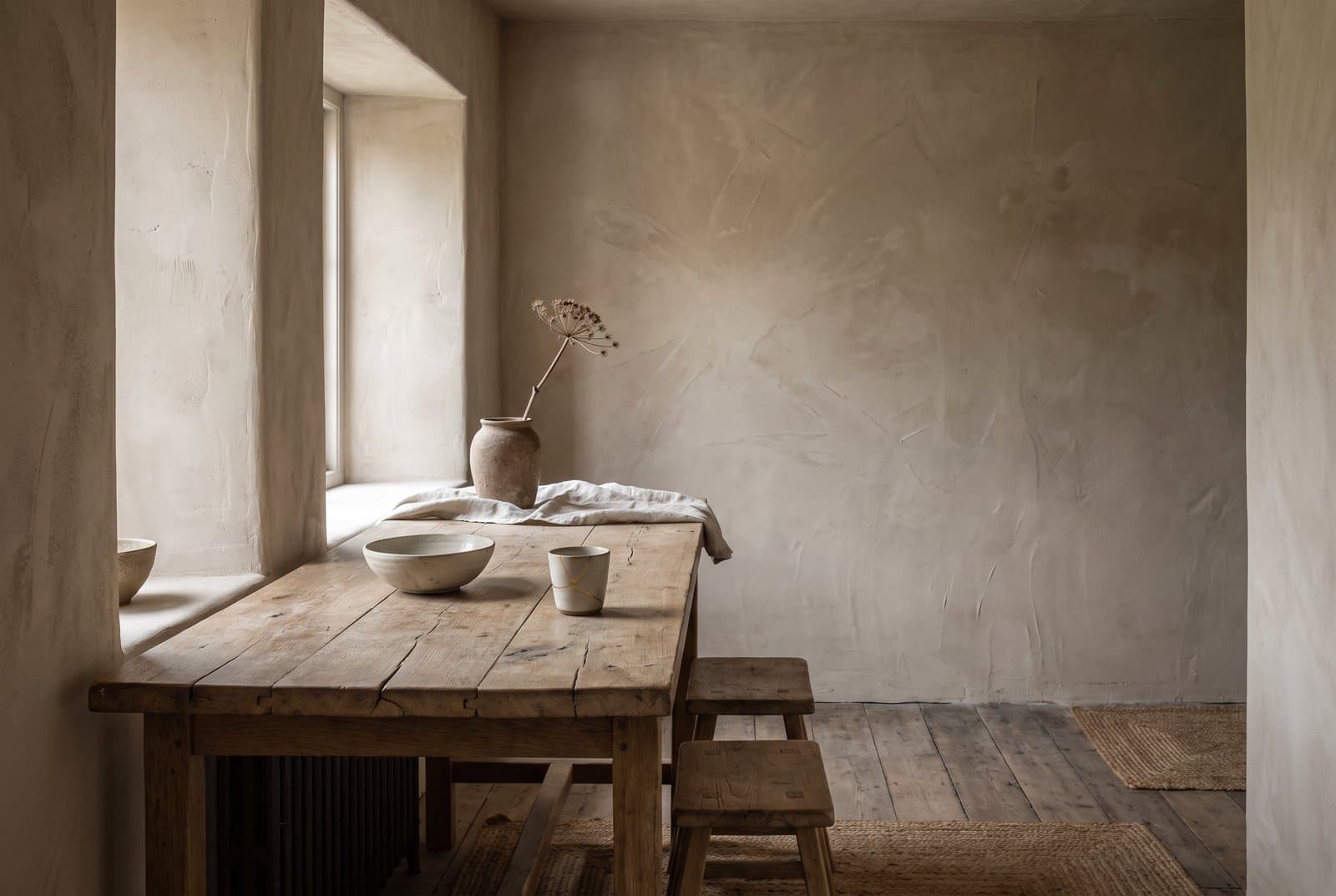
Most of us spend a great deal of effort trying to make our homes perfect. Wabi-sabi suggests we stop. It’s a Japanese way of seeing that finds beauty in things that are worn, handmade, imperfect and changing, and rooms built on it are among the calmest there are.
I touched on it in Japanese interior design: 9 secrets to a calmer, quieter home. Here it gets the space it deserves.
What wabi-sabi means
The phrase joins two old Japanese words. Wabi is the beauty of quiet simplicity, of a modest life lived close to nature. Sabi is the beauty that comes with age: the patina on metal, the silvering of timber, the softening of a well-used thing.
Together they describe a way of seeing rather than a style. Wabi-sabi is often summed up in three simple truths: nothing lasts, nothing is finished, and nothing is perfect. That isn’t sad. It’s freeing.
Where it comes from
Wabi-sabi grew from Zen Buddhism and the Japanese tea ceremony. In the 16th century, the great tea master Sen no Rikyū favoured plain, rustic tea bowls and simple tea rooms over ornate, costly ones. The beauty, he believed, lay in modesty and naturalness.
The idea reached a wider audience in the West in 1994, when the American writer Leonard Koren published a small book called Wabi-Sabi for Artists, Designers, Poets & Philosophers. It has influenced designers ever since.
A lovely example is kintsugi, the Japanese craft of mending broken pottery with lacquer and gold. The break isn’t hidden. It becomes the most beautiful part of the piece.
Why imperfect rooms feel so calm
Perfect rooms ask a lot of us. Every scratch is a worry and every mark a mistake. A wabi-sabi room asks nothing. It has already made peace with time, so you can simply live in it.
Natural, imperfect surfaces also give the eye something gentle to rest on. A hand-plastered wall, the grain of old oak and the creases in linen are endlessly interesting without ever being busy. And because the materials are honest and matt, the light falls softly. It’s the same quality I wrote about in What is rustic luxury? Why matt, natural rooms feel so calm.
7 ways to create a wabi-sabi room
1. Choose walls with a hand-made finish
Clay plaster, lime plaster or limewash, applied by hand so the marks of the trowel or brush remain. Gentle movement in a wall is the quickest way to bring wabi-sabi into a room. There’s more in Limewash walls: what to know before you pick up a brush.
2. Let wood be wood
Choose solid wood with its knots, grain and small cracks on show, oiled or waxed rather than varnished. It will mark and soften with use, and that is exactly the point.
3. Live with handmade things
A hand-thrown bowl, a woven basket, a carved spoon. Handmade things carry the marks of the person who made them, and no two are the same. A few good ones are worth more than a shelf of perfect ones.
4. Choose natural, undyed textiles
Linen that creases, wool that pills a little, cotton that fades in the sun. Leave the creases in. Undyed and softly coloured fabrics suit wabi-sabi best.
5. Keep the palette earthy
Clay, stone, oat, bark, moss and soft grey. Colours taken from the landscape, close together in tone, so the room feels quiet and whole.
6. Mend rather than replace
A chair with a worn seat, a cup with a chip, a table with rings on it. Wabi-sabi treasures the things that have been used and loved. Mend what you can, and let the mending show.
7. Bring in something from nature, as it is
A single branch, a seed head, a stone from a walk, a few dried grasses. Choose one, give it space, and let it change with the seasons. A dried stem is as beautiful as a fresh flower.
Where wabi-sabi can go wrong
Wabi-sabi is not an excuse for a scruffy room, and it isn’t a look you can buy all at once. Mass-made things designed to look rough, or brand new furniture with a fake worn finish, miss the point entirely. The imperfection has to be real.
It also isn’t clutter. A wabi-sabi room has very few things in it, so that each one can be seen and enjoyed. In that, it’s a close cousin of Minimalist interior design: 9 ways to live with less and love your home more.
Wabi-sabi in the garden
Gardens may be the easiest place to practise wabi-sabi, because nature does the work. Moss on stone, timber left to silver, seed heads left standing through winter, a path worn by footsteps. Choose plants that age beautifully and resist the urge to tidy everything away in autumn. Keep the planting peat-free.
The studio designs gardens, courtyards and balconies in the same way as rooms, and I’ve explained how in Online garden design: can it really work from a few photos?.
Wabi-sabi and rustic luxury
Wabi-sabi sits at the very heart of rustic luxury, the one style Sunday Ambience designs in. Honest matt materials that age well, handmade things, a quiet palette and far fewer, far better pieces. If you love its spirit, tell me and it becomes part of the brief. It also runs through Japandi interior design: 7 ways to make it warm, not cold.
If this is the home you’d like
The Sunday Signature package is £1,495 for one room, designed in real depth, with photorealistic visuals and a concept walk-through with Rachel, live or pre-recorded. If you’d prefer to begin more gently, Room Ambience is the lighter option at £495, with one photorealistic visual of your finished room.
Or simply send me a few photographs and tell me what isn’t quite working. I read every message myself, and there’s no obligation of any kind.