Modern farmhouse, modern rustic or rustic luxury? How to tell them apart
Three looks, plenty of overlap, and a lot of confusion. Here’s what sets modern farmhouse, modern rustic and rustic luxury apart, and how to choose between them.
Rachel Hannah
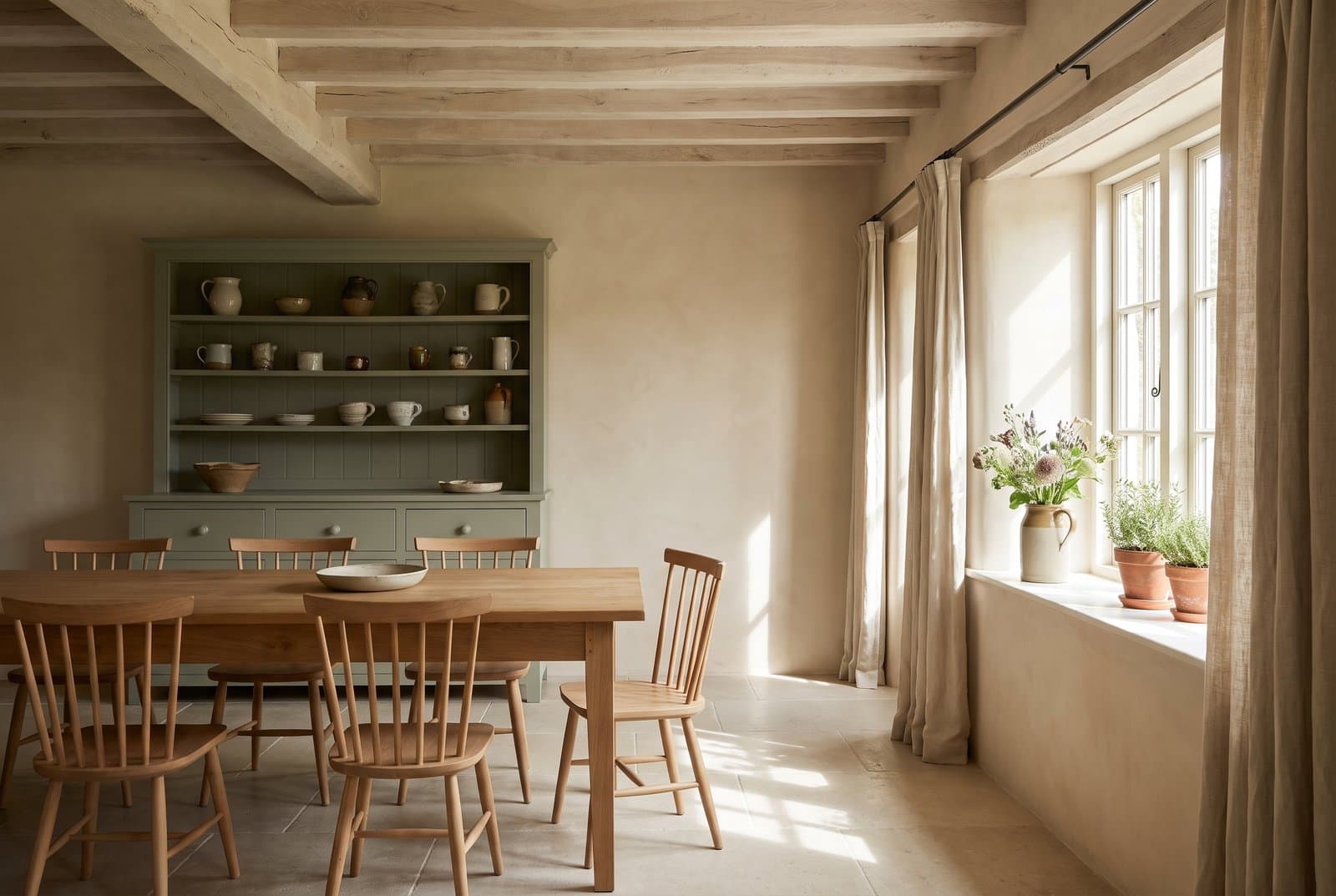
Modern farmhouse, modern rustic and rustic luxury turn up side by side on every interiors board, and they’re often used as though they meant the same thing. They don’t, quite. They share a love of wood, stone and natural light, but each one has its own temperament, and knowing the difference makes it far easier to choose what you actually want to live with.
Sunday Ambience designs in one look, rustic luxury. Modern farmhouse and modern rustic are two of the directions a design can lean towards within it, in the same way as English or French country. So here’s an honest guide to all three.
What is modern farmhouse?
Modern farmhouse took the working farmhouse kitchen and gave it a crisp, clean finish. It became hugely popular in America in the 2010s, and it has been crossing the Atlantic ever since.
A few things define it. White or off-white walls, often in boarding. Black metal for light fittings, handles and window frames. A big farmhouse sink, open shelving and a long wooden table. Plenty of contrast, between dark and light, old and new.
At its best, modern farmhouse is bright, practical and welcoming. It is a kitchen you can actually cook in, and a table everyone can gather round.
Where modern farmhouse can go wrong
The look is so popular that it’s easy to buy all at once, and that is where it tends to slip. Wood that has been printed or grey-washed to look old. Sliding barn doors in a house that never had a barn. Signs on the wall telling you to gather. It has the shapes of a farmhouse, and none of the age.
The high contrast can also feel a little cold in British light. Bright white and black look wonderful in a sunny photograph, and rather stark on a grey February afternoon.
What is modern rustic?
Modern rustic interior design starts from the other end. Where modern farmhouse is crisp, modern rustic is warm and textural. Exposed beams, stone, rough timber and wool, tidied up with cleaner lines and less clutter than a traditional rustic room.
The palette is warmer and the contrast is lower: honey and mid-toned woods, stone greys, oatmeal and earth. You’ll often see it in barn conversions and mountain lodges, and it borrows a good deal from Scandinavian simplicity.
Its weakness is the opposite of modern farmhouse. Without some restraint, all that texture can turn heavy and dark, and a room can start to feel like a ski chalet whatever the season.
And what is rustic luxury?
Rustic luxury is quiet luxury with a rustic soul. Honest matt materials, rustic warmth, a good deal of empty space, and far fewer, far better things. I’ve written about it in full in What is rustic luxury? Why matt, natural rooms feel so calm.
It takes the warmth of modern rustic and the clean lines of modern farmhouse, then adds restraint. Fewer pieces, a softer palette, and materials that are exactly what they appear to be, chosen because they will look better in ten years than they do today.
How the three differ
Colour
Modern farmhouse is bright white with black accents. Modern rustic is warm wood and earthy neutrals. Rustic luxury is a soft palette of chalk, oat, stone, clay and green, with very little contrast at all.
Materials
Modern farmhouse leans on painted boarding, white tile and black metal. Modern rustic leans on rough timber, stone and wool. Rustic luxury uses limewash, oiled oak, honed stone, linen and clay, all of them matt.
Metals
Modern farmhouse loves matt black. Modern rustic often uses iron and dark bronze. Rustic luxury prefers aged brass and bronze, allowed to dull and darken over time.
The feeling
Modern farmhouse is fresh and sociable. Modern rustic is cosy and enveloping. Rustic luxury is calm, the room you breathe out in.
Modern farmhouse in a British home
Here’s the good news. Many of us already live in the kind of house modern farmhouse is trying to imitate. Cottages, farmhouses, barns and period homes have real beams, real stone floors and real deep windowsills, and they don’t need anything pretending to be old.
So in a British home, I’d let the house lead. Keep what the building already gives you, and borrow only the best of the look: the long table, the practical kitchen, the open shelf of everyday things.
If you live somewhere newer, the same thinking still works. A modern home can take the clean lines of modern farmhouse very well, as long as the materials are honest and the palette is soft.
How to bring the look home
None of this needs a renovation, and most of it can be done slowly. Here’s where I’d begin.
Swap bright white for a softer one
A chalky off-white, or limewash where you can, gives walls the depth of old plaster and feels far kinder in British light. It is the single easiest way to warm up modern farmhouse.
Use black sparingly, or not at all
If you love matt black, keep it to one or two places, such as a window frame or a single pendant. Elsewhere, aged brass or bronze carries the same farmhouse feeling with more warmth.
Make the table the heart of the room
A long table in solid, oiled wood is the best thing modern farmhouse ever gave us. Look for an old one first. A table with marks in it already has nothing left to prove.
Keep open shelving honest
Open shelves work when they hold the things you use every day: plates, bowls, a few jugs. Styled shelves of things nobody touches soon start to feel like a shop window.
Let texture replace contrast
Instead of black against white, layer wood, linen, wool and stone in related tones. The room stays interesting, and it feels calmer.
Skip the signs
A room that is genuinely welcoming doesn’t need to say so. Flowers from the garden in a stoneware jug will always do more than a word on the wall.
Buy old before you buy new
Farmhouse furniture was built to last, and auction houses and antique shops are full of it. It’s vintage first, which is how the studio sources wherever it can.
The garden is half of it
A farmhouse was never only a house, and the look carries outside beautifully. Gravel paths, loose planting with grasses and herbs, a weathered bench and a few generous terracotta pots. Let timber turn silver, and keep the planting peat-free.
The studio designs gardens, courtyards and balconies in exactly the same way as rooms, and I’ve explained how in Online garden design: can it really work from a few photos?.
If this is the home you’d like
Whichever of the three you’re drawn to, the best version is built slowly, one good decision at a time.
If you’d like some help, Sunday Ambience designs entirely online, from your photographs and a few measurements, with every design led and approved by me. Tell me you love modern farmhouse, modern rustic, or a little of both, and it becomes part of the brief, set within the studio’s rustic luxury style.
The Sunday Signature package is £1,495 for one room, designed in real depth, with photorealistic visuals and a concept walk-through with Rachel, live or pre-recorded. If you’d prefer to begin more gently, Room Ambience is the lighter option at £495, with one photorealistic visual of your finished room.
Or simply send me a few photographs and tell me what isn’t quite working. I read every message myself, and there’s no obligation of any kind.